| 
Feature: James Haddrell
ON MAY 19, 1960, the French Patent Office issued patent number
63471, protecting the applicant’s rights in connection with
the invention of IKB.
This came three years after the Sputnik mission took the first
man into space, one year after the World Health Assembly committed
to the global eradication of smallpox, and just one year before
the first manned flight to the moon, but patent number 63471 was
not issued for a work of engineering that would advance the space
race, or for a medical advance in the fight against illness.
It was issued to French artist, Yves Klein, for the invention
of a colour.
In the years leading up to 1960 Yves Klein had been refining
his use of colour, striving to capture a shade of blue that would
encompass his entire experience - eradicating the horizon and
combining the earth and the sky, laying bare the range of his
own emotions, unlocking an experience of the endless void of space,
but the right blue was hard to find.
Whenever he found a pigment that satisfied him, the process of
mixing it with any agent in order to apply it to a canvas changed
the shade and destroyed the effect.
It was finally with the help of a chemical retailer that he found
the solution. By adding a mixture of ether and petroleum to his
pigment, he was able to retain the shade of blue in the finished
works.
It was this process for which he was granted a patent, and it
was his religious dedication to this colour, used without variation
on canvas, in three dimensional sculpture, applied to the human
body and even set in mechanical motion, which earned him the nickname
Yves - le Monochrome.
Klein’s repeated use of a single colour certainly announced
his presence on the Parisian art scene, but the association of
a specific colour with an artist was hardly new.
The work of countless painters, from the medieval church paintings
of Giotto to the nightmarish visions of Van Gogh have shown painterly
love affairs with the colour blue, but only Klein went so far
as to claim singular ownership of his blue.
For Klein, his choice of colour was not a part of his artistic
creativity or a part of his approach to the viewer – International
Klein Blue contained within its own purity of colour the whole
act of creation itself.
The latest exhibition to open at the Barbican Art Gallery
– an eclectic celebration of colour in modern and contemporary
art - takes a number of works by Yves Klein as its starting point
- and it is easy to see, particularly in the large scale Blue
Monochrome, Untitled (IKB 46), how the artist could become
so obsessed with the colour.
The consequences of Klein’s patented mixture are clear,
the pigment maintaining a lustre rarely seen on a dry canvas,
giving the impression not of a flat surface but rather of an infinite
void of colour.
The other works in the exhibition, from sculpture and painting
to light installation and photography, explore several of the
roles that colour has played in art since the apparent revolution
of Klein’s monochrome experiments.
In Andy Warhol’s repeated prints, here represented by macabre
cartoon skulls and bloody road accidents, the colouring of an
image loses all significance, with the same image reproduced over
and over in different hues.
|
 |
Dan Flavin, James Lee Byars and Anish
Kapoor all explore the role of colour in the natural world. Flavin’s
Untitled (to Bob and Pat Rohm) is all about the
way we physically see colour, playing with the notion of rose-tinted
vision.
Stepping into a small side room off the gallery, we are faced
with a square of various coloured neon tubes – red tubes
face us, with orange and green angled away.
The result is to turn the room a pale green, but returning to
the main gallery everything takes on a rosy hue, the work having
literally (if only for a few moments) changed the way we see the
world.
Byars and Kapoor have both created stylised artificial forms
from natural materials.
Byars’ perfect sphere of 3,333 real red roses will chart
the way in which naturally occurring colour changes with time,
as the flowers fade and decompose over the months of the exhibition;
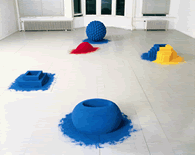
Kapoor uses earth as his material but transforms it into primary
coloured granules, much like paint, and models it into fragile
looking architectural forms.
Some of the most affecting pieces are those which reject colour
altogether.
Whilst Sophie Calle’s collection of statements from blind
interviewees seems out of place – a lack of colour is not
the same as a lack of vision – Felix Gonzales Torres’
700lbs of silver-wrapped black sweets encapsulates the dark gap
that’s left when childhood passes.
What we would love to be a Willy Wonka style fantasy, a bright,
multi-coloured mass of childish dreams, is instead reduced to
a colourless, characterless mass of black confectionery, with
all of the magic drained away with the absent colour.
Similarly, in Bruce Nauman’s rotating neon writing - White
Anger, Red Danger, Yellow Peril, Black Death –
it is the black reference that is most poignant.
Whilst the other neon statements each share their meaning with
their illuminated colour, ‘Black Death’ only rings
true when the light is turned out – when lit, the blue of
the tube is clear, and the message makes no sense. Only without
colour, with the tube dulled to black, can death be understood.
For Nauman, it seems, colour is indivisibly connected to life.
Whilst Klein’s religious dedication to single colours,
and to IKB in particular, forms the starting point for Colour
After Klein, the sheer diversity of work on display proves
that his purification of colour was more of a charismatic dead-end
than the beginning of a colour-centred artistic revolution.
With the re-introduction of narrative, of sound, of text, of
interaction with the viewer, the 19 other artists featured in
the exhibition celebrate the place of colour in nature and its
artificial subversion, the place of colour in dream and fantasy,
the emotional associations of colour and even the absence of colour
– creating, in all, a broad celebration of colour that Klein’s
monochromatic purism could never have allowed.
Featured artists
Bas Jan Ader, Louise Bourgeois, Joseph Beuys, Sophie Calle, William
Eggleston, Spencer Finch,
Dan Flavin, Felix Gonzalez-Torres, Mona Hatoum, Donald Judd, Anish
Kapoor, Yves Klein, James Lee Byars, Bruce Nauman, Helio Oiticicia,
Gerhard Richter, Pipilotti Rist, Anri Sala, James Turrell, Andy
Warhol
Colour After Klein
Until September 11, 2005
Barbican Art Gallery, Silk Street, London. EC2Y 8DS
0845 1207550; www.barbican.org.uk/gallery
Daily 11am–8pm; Tuesday & Thursday 11am–6pm
Tickets: £8; £6 concessions
Book online and save £2 on full price tickets.
Picture credit: Anish Kapoor, Part of the Red, 1981
Courtesy of Lisson Gallery, London
© the artist
|


