


|
|
|||||||||
|
||||||||||
|
||||||||||
|
|
||||||||||
|
||||||||||
 |
Story by Jack Foley |
  |
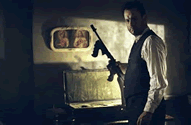
WHEN Tom Hanks announced that he would be playing a hitman for his next role,
in Road To Perdition, a few eyebrows were raised.
Could the man behind such all-American nice guys as spaceman Jim Lovell (Apollo
13) and, of course, Forrest Gump, possess what it takes to convince as a stone-cold
killer.
And what made the star decide on such a sudden, dramatic change of image?
"I remember thinking that here is this movie that should be predictable
but is utterly unpredictable," reveals the star, when talking about what
drew him to the project.
"That, coupled with the realities of what it was going to take to make
this period piece… I wondered who they could get to do it justice.
"It turned out to be Sam Mendes. Chatting with him, I knew we would be
in the hands of someone who could tell the story the way it needed to be told."
And while Hanks’s admiration for his director is of the highest quality,
Mendes is equally gushing in his praise of the actor.
"How can you not admire Tom Hanks?" he asks. "He’s an
amazing actor, but what’s even better than having a great actor is having
a great actor who’s never before done what the part is asking of him.
"Michael Sullivan is a very dark, very mysterious man, and not at all
accessible to the audience, at least initially. He is someone who carries
with him a sense of guilt and regret for the life he has led, but this regret
is never stated; it is just felt and seen.
"What Tom is able to convey in silence is extraordinary, but then, that
would be my definition of a great screen actor."
Hanks concurs with Mendes on this point and felt drawn to the character of
Michael Sullivan from a very early stage.
"While I was reading this, I actually thought of the verse from The Bible
that says, ‘He who sows the wind shall reap the whirlwind’, and
that’s what happens to Sullivan.
"He’s married, the father of two, and has one of the bigger houses
in town… and it’s been paid for with fear, intimidation, violence
and blood. Now he’s in the midst of something he should have known was
coming, but somehow he was able to block out the reality of his world and
believe it would have no consequences and, of course, it finally does.
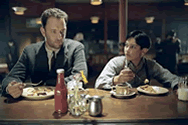 "At
the moment we’re dropped into the story, it is literally the last day
of that false perspective."
"At
the moment we’re dropped into the story, it is literally the last day
of that false perspective."
Hanks also liked the way in which the story examined the relationships between
fathers and sons and feels that, as much as anything, the movie is about ‘that
moment when the truth is revealed, when you see the flaw in the man you considered
to be your father’.
"How do you deal with it?" he asks. "Is it the shattering of
your world, or the beginning of a new understanding of the failures we as
human beings all have? Does it draw you closer to the man you viewed as the
reason you’re in the world, or does it drive you away from that person
who is responsible for who you are? It’s fascinating stuff."
It was the same aspects of the story which compelled Paul Newman to get on
board. As Mob boss John Rooney, the Oscar-winner is eventually forced to choose
between his ‘good’ surrogate son, Michael Sullivan, and his ‘bad’
real son, played by Daniel Craig.
"He [Rooney] goes through an interesting progression in the film,"
says Newman. "He starts out robust and powerful and full of vinegar,
and becomes a man beaten down by tragedy. It’s a marvellous part."
Producer Dean Zanuck is also keen to stress that Road To Perdition is as much
about father/son relationships as it is about the gangster genre, even though
the Mob elements play just as big a part in shaping the lives of its performers.
He said: "Michael Sullivan and his son start the movie apart from each
other, but a terrible turn of events brings them very much together. It’s
an emotional journey as much as a physical one that they go through.
Co-producer, Richard Zanuck adds: "It’s an exploration into a man’s
relationship with his son, and of how a fuller and more meaningful relationship
is brought about by tragedy. That is the crux of the story."
 And
the final word on the subject goes to Mendes: "At the centre of the film
is a relationship between a father and a son, but there are actually two fathers
and two sons. One of the great ironies of the film is that, although the two
fathers love each other, in each having to protect his less favoured son,
they are set on a course of mutual destruction.
And
the final word on the subject goes to Mendes: "At the centre of the film
is a relationship between a father and a son, but there are actually two fathers
and two sons. One of the great ironies of the film is that, although the two
fathers love each other, in each having to protect his less favoured son,
they are set on a course of mutual destruction.
"That is the core of the story: two men protecting their children. In
the end, what can be more important than that?"
RELATED STORIES: Click here to see clips
from the film or hear interviews with its stars...
Click here for Indielondon's verdict
on the movie...
Click here to find out what the
US critics thought...
