| 
Review: Jack Foley
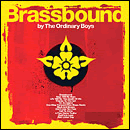
I MUST confess from the outset that I haven't really been a massive
fan of The Ordinary Boys and their latest single, the ska-heavy
Boys Will Be Boys, did little to change my opinion.
Needless to say, their follow-up album to Over The Counter
Culture is a similarly ska-heavy celebration, yet it does
at least draw on a few more influences and is much better than
I could initially have hoped for.
The Worthing-based foursome (three of whom are still in their
teens) have actively sought to expand their sound, taking their
hardcore punk roots and mixing it with their growing love for
songwriters such as Elvis Costello and Stevie Wonder.
Hence, Brassbound contains elements of dub and reggae
to break-up the ska and punk.
The result is a progression of sorts - still quintessentially
The Ordinary Boys, courtesy of Sam Preston's distinct vocal style,
but more adventurous and, well, more fun.
So does that make me a convert? Almost. The album contains more
than its fair share of highlights.
From the Clash-inspired Life Will Be The Death of Me,
which contains riffs straight out of the I Fought The Law
songbook, to the Jackson Five-inspired groove of On An Island,
there is much to suggest that The Ordinary Boys are maturing into
a really strong band.
James Gregory's bassline still lies at the heart of most of the
tracks, but William J Brown's guitars show greater scope and a
little more restraint, and new drummer, Simon Goldring (who replaced
Charles Stanley in January) adds a little more diversity to some
of the rhythms.
Thanks To The Girl, a punk-rock crossover with a breezy
'I don't mind' chorus, is evidence of the sound of the band working
well together and growing more ambitious.
It still contains the cheeky lyrical style that marked out their
debut, but the music is far more layered and downright infectious.
Skull and Bones is another lively blend of bass and
guitar, while Red Letter Day even begins with a string
intro, before emerging as one of the album's most ambitious tracks
- a slow-builder of genuine worth that hints at an even broader
sound for the future.
Of course, there are moments when the album resorts to formula
and feels like it's on auto-pilot.
Tracks such as Don't Live Too Fast and A Call To
Arms sound like album fillers, and are fairly generic for
this sort of punk sound.
There's even a cover version, of Locomotive's 1968 single, Rudi's
In Love, which is fun but hardly a stretch for them.
But on the whole this is an accomplished return for The Ordinary
Boys which is all the more impressive for arriving just 12 months
after their debut album.
The boys are clearly having fun indulging their passions and
expanding their influences, and fans will probably have the same.
Play
The Ordinary Boys' game
|


