| 
Review: Jack Foley
PORCUPINE Tree have always defied easy classification - and deliberately
so.
Some of their guitar riffs hint at grunge and metal, yet they
are not metallers.
Some of their songs unfold like mini rock-operas, clearly influenced
by the likes of Zeppelin and Sigur Ros. Yet they are no mere copycats.
Just occasionally, they'll drop a deeply heartfelt record/ballad
that forces you to check whether you're still listening to the
same band! But they're not a pretty-boys or commercial sellouts.
Rather, this unique London-based quartet delight in their ability
to make unconventional, uncompromising music that qualifies them
as Europe’s premiere art-rock cult band.
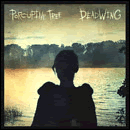
Deadwing is their eighth studio album and continues
to provide a brilliant showcase of their diversity.
Steered by primary songwriter and guitarist/producer, Steven
Wilson, and powered by keyboardist, Richard Barbieri (heralded
in musicological circles for his work in proto-new wave icon band
Japan), the album comprises nine songs that veer from the outrageously
excessive to the downright tender.
Album opener, Deadwing, clocks in at over nine minutes,
for instance, and features some brutal instrumentation, not to
mention plenty of changes in tempo.
While the hard-rocking style of Shallow is pure rock
'n' roll, conjuring memories of Foo Fighters mixed with Zeppelin.
It has been influenced by Wilson’s work as producer/collaborator
with Swedish death metal stars, Opeth.
Yet the album really takes off with Lazarus, a piano-driven
ballad of shimmering beauty that was inspired by Steven's work
with celebrated Israeli musician, Aviv Geffen, with whom he created
the side-project, Blackfield.
It's a completely beguiling record that displays the tender,
more fragile sound of Porcupine Tree, and which continues to astound
the more times you hear it.
Halo, too, is another outstanding effort made all the
more satisfying by the presence of legendary guitarist, Adrian
Belew (King Crimson, David Bowie).
It contains one of the best choruses on the album, one which
evokes memories with the vocal style of The Charlatans, and which
is probably the sound of the band at its most commercially accessible.
Arriving Somewhere But Not Here is a deeply atmospheric
record containing plenty of surreal lyrics ('did you imagine the
final sound is a gun, or the smashing windscreen of the car, did
you ever imagine the last thing you'd hear as you're fading out
was a song') that lend it a haunting, hypnotic quality before
unleashing the guitars.
While Mellotron Scratch is another of the band's chilled
out efforts, which lulls you into a false sense of relaxation
before upping the tempo after four and a half minutes for another
set of guitar solos and a falsetto-vocal style.
It's a defining feature of the album as a whole, though, that
tracks aren't prepared to follow one particular path, continually
evolving and forcing the listener to pay attention.
Having mellowed out during the middle part, it should therefore
come as no surprise to find the thunderous guitar riffs making
a return for Open Car.
While album closer, Glass Arm Shattering, is an epic
slow-builder that infuses its lyrics with the sort of guitar energy
that was synonymous with Pink Floyd and a vocal style not dissimilar
to the Super Furry Animals.
It's not a surprise that the last line of the album is 'feeling
all your love' as, after hearing the album in full, you can't
help but hold Porcupine Tree's Deadwing with nothing
but affection.
Editor's note: The Porcupine Tree story goes
back to 1988, when London teen, Wilson, and his mate, Malcolm
Stocks, concocted a fictional psychedelic band called Porcupine
Tree.
By 1993, Wilson had assembled an impressive touring and recording
ensemble that included revered keyboardist, Richard Barbieri,
the talents of bassist, Colin Edwin, and drummer, Chris Maitland,
who was later replaced by extraordinary drummer, Gavin Harrison.
Twelve years and with 400,000 plus album sales under their belt,
Porcupine Tree is far more impressive than the non-existent group
once imagined.
|


