| 
Feature: Jack Foley
THERE'S good reason why the US is currently embracing an exciting
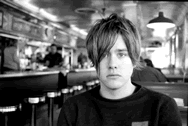
new talent called Johnathan Rice.
Not only is his debut album, Trouble Is Real, gaining
him widespread critical acclaim and had TV musical directors falling
over themselves to get in on the act, he’s earned supports
slots from as eclectic a selection of artists as you would expect,
and he has caught the eye of the casting directors for the much
anticipated Johnny Cash biopic, Walk The Line,
starring Joaquin Phoenix and Reese Witherspoon.
It's fair to say, even at this early stage, that this young man
is going places.
Here, IndieLondon's Jack Foley catches up with Johnathan about
his forthcoming projects and success so far...
Q. It’s been a terrific year for you - with a successful
album, widespread acclaim and a forthcoming movie. Do you ever
have to pinch yourself?
A. I'm not one for looking back. My thoughts are usually
directed towards the immediate right now rather than what has
already happened.
Things tend to glow for a while but then they start looking old
and tired. I'm always more attracted to what's going to happen
rather than what's already happened and therefore cannot be changed.
This record has only been out for a few weeks and in my opinion
it remains to be seen whether or not it will be successful.
I guess I'm somewhat superstitious, it's residue from my Catholic
upbringing, but I feel that it's dangerous to believe any kind
of praise or approval from the press or media, because then you
have to then believe all the bad things they're bound to start
saying sooner or later.
There's so much smoke sometimes that it's hard to see. The only
way I can really gage what's going on is by playing the live shows
and feeling what's going on in that particular room on that particular
night, and really digging into an audience and seeing what I might
be able to pull out.
That's something that really makes me really happy and gives me
satisfaction. So no, I don't pinch myself, but sometimes a feel
a small electric shock.
Q. New single, Kiss Me Goodbye, is an instant
classic – how long did it take to write and who or what
inspired it?
A. An instant classic? My oh my. I don't know about that
at all. Didn't it just get released last week?
That's very nice of you to say, of course. I feel like I owe you
some money now.
I wrote this song with my long lost friend, Chris Keup, in an
apartment in the Upper East Side of Manhattan when I was about
18-years-old.
I think we had been listening to old Lemonheads' records and started
to talk about writing something real jangly.
The song's a toe-tapper and little else. On some of the songs
on this record, the guitars and the drums and the keyboards are
more important than the words I'm singing.
I would put this one in that category. Pop goes the weasel. I
like playing it live with the band, it gets the blood moving.
It makes me a little sad to think of Keup though. Chris was the
guy that got me started, a man I looked up to very much and wanted
to impress. He recorded my first ever songs and for a good long
while became my songwriting partner.
He made it all seem like the real thing, like this sort of life
was actually possible.
He had this amazing quality that made him seem like he was a lonely
visitor from an older, purer time.
I always had more ice in my blood than he did and wanted to go
out and take over the world like a cocky teenager often wants
to do.
He and I have drifted apart, creatively and physically. He lives
on a farm out in a really beautiful part of Virginia like some
character from a Cormac McCarthy book and has a real quiet life.
I on the other hand am in a hotel room in London and currently
live nowhere. One of the things you learn real quick in this line
of work is that there are lots of trap doors and rabbit holes
that your friendships can fall through and never be seen again.
Q. The album contains many memorable songs – some
of which seem deeply personal, others that are reflective of current
events. City on Fire, for instance, contains obvious
nods to the events of September 11, 2001. How did those events
affect you given that you had set out for NYC on September 10
with 1,000 copies of your songs?
A. I don't think there's any other place in the world
that means more to me than New York City.
It was the place where I began my real life, my life as I shaped
it.
Even when I was a kid I imagined at some magical underworld, the
loudest and fastest place there was and filled with ghosts.
It seemed to me to be the only logical place to go to do what
I intended to do.
The whole place reeks of destiny. City on Fire was the
first song I wrote when I got there. On September 9, 2001 I drove
my books and clothes from Virginia to my new place in the Upper
West side and I was sitting out on the fire escape with my guitar.
These Puerto Rican kids were scurrying around on the ground below
me and were lighting up little red firecrackers that exploded
and sounded huge bouncing off the complex walls.
|
 |
The smell of the fuse and the powder
came up to where I was sitting and I started the first few lines
of the song.
I worked on it pretty steadily the next day and was about halfway
through. Then I watched the buildings go down the following morning
and the character of the song changed immediately.
That sound at the beginning of the song on the record is what
that day sounded like to me.
I can't really say exactly how that whole event informed me creatively,
but I'm sure that it did in a subconscious way.
For me it was a really jarring and razor sharp way of bookending
my childhood and my new life on my own.
New York was the place where all the movies I'd seen and books
I'd read and records I had listened to materialized into reality.
I saw Central Park in the middle of the Fall and I saw my roommates
giving head to tax attorneys. I worked in restaurants and drank
the table wine the patrons left and went home and saw cocaine
up close for the first time as it disappeared up some dealer's
nose before he OD'd.
I played my songs down in the Lower East Side and ate what I took
from the bakery where I did the morning shift.
I would return home to Virginia for Thanksgiving dinner and I
didn't even see in the same colors anymore.
Q. You first picked up a guitar at the age of eight,
didn’t you? Does that seem like a long time ago now? Who
inspired you? And how encouraging were your parents?
A. I got signed to Warner Brothers when I was 19 in the
summer of 2002.
I was back in Virginia, broke and wondering what to do next. They
flew me out to Los Angeles and I lived on the top floor of the
Standard Hotel on the Sunset Strip for a month.
They offered me a deal based on demo recordings I had made in
my bedroom back in Virginia. I was relieved to say the least.
That meant that I could eat for a good long while and make a couple
of records, which was a lot more than I expected when I started
this whole thing.
Q. What was working with producer, Mike Mogis, like?
A. Mike Mogis saved the record. Trouble is Real is
really a collaboration between he and I because he put as much
into it as I did if not more.
You see, I'm not much of a musician in the technical sense, and
I had all these ideas and sounds in my head that I was unable
to articulate to these uptight people I had worked with up until
I got to Nebraska.
I use words to describe what I want to happen, not charts or voltage
measurements.
Mike and I (and also Nate Walcott who arranged all the strings
and horns) had a pretty seamless dialogue and we were able to
achieve things together that we wouldn't have on our own.
It was kind of like being in a band that formed for a while, put
out one record, and broke up as the best of friends.
Q. You’ve toured with the likes of Starsailor,
Rachael Yamagota, The Cardigans, Ray Lamontagne, Maroon 5, Gomez
and latterly Martha Wainwright – all terrific artists. Which
provided you with your best experience? And how much did you learn
from each of them?
A. I've been touring constantly for about two or three
years now and it all tends to blur together into one long day
and one extremely long
night.
The last UK tour was my favorite so far, cause we were the headliners
and could really work it out every night and on a coupla nights
we got to open for REM.
Other than that, I guess my other favourite tour was with Martha
Wainwright. I thought her audience was real sweet and had an understanding
of the kind of music I was playing.
She and the boys in her band are among the sweetest people in
the game.
Also, it was great to warm the place up for her every night so
she could proceed to burn it down. That chick can fucking SING.
Q. TV shows like The OC have helped to provide several
artists with a groundswell of attention recently (Imogen Heap/Phantom
Planet). How much did it mean to you to get your tracks featured
on popular shows like The OC, Smallville and Six Feet Under?
A. I'm not at all shy or sheepish about this whole music
and TV show thing.
Some bands get a little high-brow and precious about it, but I'm
very much into it. I think it's wonderful exposure for music that
otherwise might not be heard by kids everywhere.
People who make music like mine are oftentimes met with outright
hostility from US Commercial radio, which is set up kinda like
McCarthy's Commision of Unamerican Activities from the 50's.
So, if we put our songs in a TV show, it will reach people with
the same immediacy and power that the radio USED to provide.
Some kid in Des Moines Iowa is gonna hear Death Cab For Cutie
on The OC and be introduced to a whole new world that the radio
would have never showed him.
I think it's cool. Sign me up.
Read Johnathan's
views on his upcoming movie, Walk The Line...
Trouble Is Real
reviewed
|


