


|
|
|||||||||
|
||||||||||
|
||||||||||
|
|
||||||||||
|
||||||||||
By Jack Foley
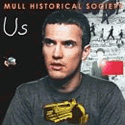 MULL
Historical Society, otherwise known as singer/songwriter Colin MacIntyre,
is to follow up the huge acclaim that greeted his Loss debut last year,
with a new Blanco/WEA album, entitled Us, on March 3.
MULL
Historical Society, otherwise known as singer/songwriter Colin MacIntyre,
is to follow up the huge acclaim that greeted his Loss debut last year,
with a new Blanco/WEA album, entitled Us, on March 3.
Recorded in Scotland earlier this year, all 14 songs are MacIntyre compositions/productions;
and tracks include the first single - set for release on February 18 release
- The Final Arrears, which is already getting airplay on both XfM and
Radio 1.
Other tracks to look forward to for fans include Am I Wrong, The Supermarket
Strikes Back, Don't Take Your Love Away From Me, Gravity, Asylum and
Clones.
Mull Historical Society will also be out on tour in March and April, with
a London date confirmed for Shepherd's Bush Empire on April 3.
Loss emerged in the autumn of 2001 to universal acclaim, and went on to sell
upwards of 100,000 copies in the UK.
The album featured extensively in that year's 'best of' polls and delivered
a clutch of classic singles such as Watching Xanadu and the debut,
Bar Code Bypass.
About Mull Historical Society
Colin McIntyre is Mull Historical Society. He writes their songs, sings their
vocals, plays their instruments and produces their records. He even designs
the sleeves. Heck, the only part of the band he didn't create is its name.
But on July 3 2002, in the midst of recording their ace second album, he finally
met the people who did.
Even though Colin hasn't lived on the beautiful Scottish isle of Mull for
years (he recently moved from Glasgow to London), with a population of just
2,500, the chances of bumping into those responsible for his band's name on
one of his visits back were always high.
And sure enough, as he stood up to deliver the speech he'd been asked to give
at his old school's presentation day that July afternoon, Colin was told that
several members of the real Mull Historical Society were in the audience.
"I've never been more nervous than standing in front of the school doing
that speech," he admits. "And to find out some of the real Society
members were there made it even worse. I actually thought I'd pissed myself
with nerves. The first thing I did was to apologise to them for two years
of focus they could have done without."
He probably needn't have bothered. After all, Colin's decision to borrow the
Society's name for his band has surely made them the UK's most famous local
history group. They've seen their organisation namechecked everywhere from
CD:UK and the Top 40 singles chart to The Face and The Daily Telegraph.
Marrying the experimental instincts and rich instrumentation of the Beta Band
and Flaming Lips with the belting pop sensibility of The Beatles and The Las,
debut album, Loss, attracted huge critical acclaim and sold 200 copies. A
further hat-trick of belting singles (I Tried, Animal Cannabus and the Top
40 hit Watching Xanadu) led to a series of inflatable sheep-infested gigs,
and saw Colin and his live bandmates emerge from supporting The Strokes on
their toilet venue debut UK tour to headlining a packed Shepherds Bush Empire.
The stage was set for album number two and, early last year Colin - a prolific
tunesmith since his childhood - went back to the studio with countless songs
to work on. Ninety-five recording days later, he emerged with Us, an album
laden with Colin's trademark tales.
The album is said to mark an obvious progression for Colin, who comments:
"I think I've stripped things down I've still tried to use different
instruments and to really push myself, but it's more concise this time.
"When I was recording it, some of the songs had 90 separate tracks on
them, but when I was mixing it I was much more brutal than with 'Loss'. I
took away so much stuff that I'd added. Y'know, sometimes you don't need keyboard
zaps.' Instead the songs have been given room to stand up for themselves.
'Us is also a more overtly personal record than 'Loss'. On the first album,
I tried to relay a lot of my thoughts and emotions through characters,' admits
Colin, 'but there's less of that on 'Us'. It is a lot more about me.'
Not surprisingly, Colin is incredibly pleased with the album.
"I loved recording it," he says. "I felt really confident with
the songs I had to choose from. In fact, in the studio there'd be times I
was actually hurting because of how many songs I was trying to deal with.
But the 14 that became 'Us' just rose to the top."