


|
|
||
|
|||
|
|||
|
|
|||
|
|||
 |
Review by Paul Nelson |
|
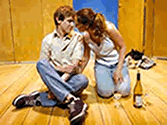
Glyn Williams (Ben) & Isobel Pravda (Claire) |
|
A GOOD argument in favour of writers possessing a paper shredder is the script
of the show at the New End in Hampstead. It is a script Casey Robinson
would sue over, he assuming that someone has been through his wastebasket,
and if anyone has seen the film Now Voyager, for which Robinson wrote
the screenplay, they will know exactly what I mean.
The play with a female leading character, instead of a young man, would be
a weepy and would have been bought up by Warner Brothers or any of the major
studios in the forties if they hadn't already done it.
As it is, it deals with Obsessive Compulsive Disorder* (OCD) which is suspiciously
like the condition the late Howard Hughes had, although in this case the sufferer
isn't exactly walking about on Kleenex everywhere.
The plot of Commanding Voices, instead of having the repressed Charlotte
Vale (Bette Davis beautifully carving little boxes) has Ben Davenport (beautifully
painting pictures).
The play further imitates the 1942 movie by substituting the tyrant mother
(Gladys Cooper) for the tyrant father Edward Davenport. The family doctor,
down to earth George Bradley, is an amalgam of Dr Jaquith (clever Claude Rains
in the movie) and Sister Kenny. However, the similarity between it and other
films doesn't end there. This load of tosh really is the result of discovering
the mother lode of discarded old Hollywood scripts and revamping of them.
Ben Davenport is a very talented fine artist; he can handle portraiture or
animal studies with equal talent and aplomb. He has an ardent desire to study
art and has applied to join the Slade. His father Edward has other ideas.
He is a Member of Parliament, an academic who has forsworn Oxford in the hope
that he will become an Education Minister. He wants his son to go to Oxford
and study politics and economics, something the boy is loth to do. Ben's mother
Helen is a talented classical pianist and she has forsworn a musical career
for her marriage to Edward. Ben having been accepted by the Slade forswears
his artistic career and obeys his father.
Family doctor and friend, Good Old George has forsworn his practice due to
retirement, is a widower and now lives in bucolic bliss in the country. Up
at Oxford Young Ben meets Claire, a French charmer who is studying for her
finals. Claire's parents understand her so she hasn't forsworn anything. She
is also a talented artist and the two become an item.
During a long and predictable labyrinth of play plotting, Edward doesn't get
the job but is given a substitute in Health. Ben has a nervous breakdown due
to OCD, Claire leaves him and returns to France and Ben is put to a particularly
unsympathetic psychiatrist, Dr Henry Grubshaw, specialising in OCD, but one
who, it transpires, isn't too well himself, so Ben shows no progress.
From here, the plot becomes more convoluted.
Edward has a heart attack, Helen picks up her career again and goes on a blindingly
successful series of concert tours, and decides, between tours, that enough
is enough. Ben should be taken away from Grubshaw and good old George should
be given a chance.
Good old George with his folksy garden herb cures and down to earth good old
fashioned ideals, has a go at curing the psychiatrist of arthritis, curing
Edward, and succeeds in curing Ben. There is a dark hint however that Ben's
illness could recur.
Claire returns from France all shining eyes, the romance having started again.
Edward and Helen mutually realise what they have been missing. Edward is offered
the original job he craved but decides he wants to finish the one he is on,
and just before that triggers off another bout of forswearing, Ben returns
to his art studies with a hint the Slade may reconsider him. The play ends
with a tableau, the parents are being painted as a group by the son.
In this improbable fairy story everything happens for the good of everybody.
For me, sadly, the last straw was the omission of Christmas, then they could
all have given each other presents.
 Starting
with unreal dialogue such as one has never heard in life, and with no real
play ever happening - a chain of events constitutes a soap opera not a play
- the evening drags on and on. The group sitting behind me became increasingly
restless as the evening unfolded, with suppressed laughter in the wrong places.
Starting
with unreal dialogue such as one has never heard in life, and with no real
play ever happening - a chain of events constitutes a soap opera not a play
- the evening drags on and on. The group sitting behind me became increasingly
restless as the evening unfolded, with suppressed laughter in the wrong places.
Once again though, the saintly actors resolutely strive; it has a magnificent
cast who deserve better.
You really do believe in the stiff-necked priggish Edward, to the point where
you want to punch him. Helen is a genuine sympathetic and pleasant character
after her initial scenes where the dialogue is wonky. Friendly old George
presents a gentlemanly nurse and all round good egg and Claire is played with
a great deal more charm than the part warrants.
Piers, the man from the ministry and Grubshaw the psychiatrist struggle with
their cardboard cutouts but manage to get admirable amounts of reality and
fun from the preposterous scenes with which they are involved. Finally, the
hero of all this, Ben, is played with such an amazing amount of talent that
I fully expect the actor to be offered all sorts of golden opportunities before
this calamity reaches the second week of its scheduled run.
It's worth seeing for Ben alone but when and if you do, try hard not to prompt
as familiar line after familiar line is hauled out, particularly in the unnecessary
closing scenes of what should be referred to as an event, for play it is not.
Commanding Voices by Robert Eddison. Directed by Richard Howard, Designed by Alex Marker, Lighting Design by James Whiteside, and Incidental music by Jeremy Nicholas. WITH Glyn Williams (Ben Davenport), Katherine Hogarth (Helen Davenport), Jeremy Child (Edward Davenport MP), John Burgess (Dr George Bradley), James Puddephatt (Piers Murray), Isobel Pravda (Claire Gaultier), and Gregory Cox (Dr Henry Grubshaw). Presented by New End Theatre at the New End Theatre, 27 New End, Hampstead London NW3. 020 7794 0022.
*An illness whose common symptoms are: obsessions with dirt, germs and contamination;
fear of acting on violent impulses; unreasonable fear of harming others; abhorrent
blasphemous or sexual thoughts; inordinate concern with order, arrangement
or symmetry; and the inability to discard useless or worn out possessions.
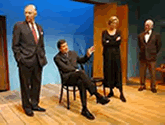
Picture two shows, from left to right: Jeremy Child (Edward); James Puddephatt
(Piers Murray); Katherine Hogarth (Helen); & John Burgess (Dr George Bradley)


