| 
Review: Jack Foley
YOU only have to look at the track titles to realise that Depeche
Mode have lost none of their dark tendencies - what with A
Pain That I'm Used To, Suffer Well and Damaged People
among the choice picks.
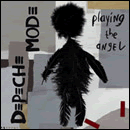
Needless to say, Playing The Angel continues to build
on the modern sound of Dave Gahan, Andy Fletcher and Martin Gore
complete with orchestral synths, warped guitar loops and heavy
atmospherics.
It's their 11th album and while not quite on a par with the seminal
likes of Songs Of Faith and Devotion, Violator or
Ultra, it remains a colossal achievement for a band that's
had its fair share of personal demons to conquer.
Produced by Ben Hillier, who has recently worked with Blur and
Elbow, the album marks a welcome comeback that is sure to delight
the fans ahead of their forthcoming tour dates.
Album opener, A Pain That I'm Used To kicks off with
an almighty blast of sound (not unlike the screeching of I
Feel You) before catapulting headlong into a suitably rousing
track that drips in the band's trademark sounds - pulsating slabs
of dance-floor synths wrapped up in a catchy chorus that contains
hints of gospel backing.
Lyrics include 'I'm not sure what I'm looking for anymore, I
just know that I'm harder to console'.
A heady dance-floor vibe surrounds John The Elevator,
which Gahan delivers in a vocally explosive style (hinting at
old-school rock 'n' roll). It's a gutsy number and continues the
good early vibe of the album.
Suffer Well is a synth-heavy, dare I say, New Order-ish
effort that again reverberates with dark, disturbed lyrics ('something's
changed and it's in your eyes, please don't speak, you'll only
lie').
And The Sinner In Me feels like a personal confession,
a rant against sin delivered with all the foreboding atmospherics
we have come to know and crave.
Former top 5 single, Precious, is probably the lightest
track on the album, a retro-blast of feel-good energy that deservedly
eased them back into the mainstream. Gahan's vocals are even softer,
perfectly complimenting a sublime beat and electronic melody.
Elsewhere, it's a mixed bag, with Macro slowing things
down somewhat (not entirely successfully) but bringing out the
intelligence of the lyrics.
I Want It All is also more ponderous, a slow-builder
that once again comes wracked in insecurity ('sometimes I try,
sometimes I lie with you, sometimes I cry, sometimes I die, it's
true').
Better still, however, are the likes of Nothing's Impossible,
with its grinding, orchestral sound-loops, and Lilian,
an angry rant against a spiteful, demanding love that contains
a dance-floor energy.
Final track, The Darkest Star, drips in melancholy,
bringing the album to a downbeat close amid some spellbinding
piano. It's a reflective finish but one that grows on you the
more you hear it.
The overall feeling, therefore, is that Depeche Mode continue
to impress - darkness, sadness, misery and despair (or 'pain and
suffering in various tempos') has seldom felt so intoxicating.
Depeche Mode's remix
album reviewed
|


