|
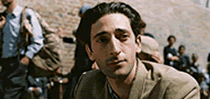
Compiled by: Jack Foley
Excerpts from a syndicated interview with Adrien Brody, as
conducted by Anwar Brett
Q. You could surely have chosen a much easier job if you'd
wanted, how much of a challenge was the role of Wladyslaw Szpilman
in The Pianist for you?
A. I certainly wasn't looking for an easy job. I like to be stretched
and challenged and tested, although I didn't know to what extent
this would be a challenge. But part of the beauty of what I do
is that it gives you the opportunity to go off and give up who
you are and really attempt to understand someone else - another
person another time, and their struggles and emotions. If you're
successful you can really experience a lot. It's very rewarding
when you can connect with them.
Q. What was the specific appeal here?
A. In this case I wanted to feel that I was being honest with
myself, and if I feel connected there's a better chance that the
audience will feel connected. Sometimes I see something that I've
done that I didn't necessarily feel that I'd nailed in the way
I wanted to, or didn't interpret it in the way I meant to, or
couldn't get what I'd envisioned. And I see it later and it's
really good, and I'm surprised because it didn't move me necessarily.
But what's important is that I move me, the journey would be less
interesting for me if I didn't. I felt that I had a real responsibility
in this case more than with most roles because I was playing an
actual historical figure, and of course because of the personal
historical nature of the film for Roman Polanski, the director.
Q. He has a reputation for being quite a hard taskmaster, did
he live up to it here?
A. He did give us a rough ride, but I don't think it was unfair.
I think he expects a lot from everyone, and I expect a lot from
myself too so I identified with that. I can also understand how
he would have expected a lot from me in particular in this film
because, as he has said, this is the most personal film he's made.
It was a huge honour for me, and I felt a great deal of pressure
but at the same time he treated me with respect with regard to
my work. He's a person who will say he doesn't like you or what
you're doing, he has no problem with that. He never criticised
my work as an actor, he may have criticised my character but he
really appreciated what I was giving him and that encouraged me.
It was an interesting ride, and also he has a wonderful persuasive
quality. Perhaps if he didn't have that I might not have been
able to give him everything that he asked for.
Q. What particular qualities did you identify in him?
A. He's very charismatic. I admire his strength, I admire his
honesty and enthusiasm for things, and his curiosity in spite
of all the suffering that he's endured in his life. It hasn't
shut him off.
Q. Given the subject matter, and the losses his own family
suffered during the war, there must have been times when his emotions
were very close to the surface?
A. Sure. Mine too, because it was very difficult and painful.
I was immersed in this state of mind and really tried to embrace
this level of loneliness and isolation. It was difficult, as it
was for him too because I'm sure it brought up a lot of unpleasant
memories. But he also has a great sense of humour. I think he
has a similar way of dealing with things that have happened where
he's able to detach himself a bit and relay the information as
he's telling the story without being overly heavy.
You grasp the intensity and the seriousness yet he's not forcing
you to feel something in that conversation. He taught me a lot.
Complaining was useless with him, I tried that but it didn't go
anywhere so ultimately I stopped complaining, which is a good
lesson. You should stand up for what you believe in, but it put
a great deal into perspective and allowed me to realise that I
had less to complain about that.
Q. How much research did you do for the role?
A. Quite a bit. Roman was very helpful in that his office lent
me a lot of documentary footage and I had some literature that
I had read. And Wladyslaw Szpilman's memoirs were very helpful
as it was first hand information. But at the same time I was given
a lot of leeway with the physicality of the character, because
although he was known he was no so known that people remember
how he looked and behaved. Therefore what was important was his
state of mind and obviously connecting to him, and learning to
play the piano was also very important. Being able to play was
something that Roman insisted upon.
|
 |
Q. Was playing the piano a crucial component to the character
for you, too?
A. It helped my connection with the character, which I wouldn't
have known prior to doing the work, prior to practising the piano
up to four hours a day when I had the time. As opposed to acting
as if I was playing the piano. I started to not only know the
notes but control the levels of emotion and the subtlety within
the music which gave me a greater understanding of the story within
the music. And of the relationship between the pianist and the
piece.
Q. Does Szpilman's artistry also inform your view of the character,
a man of great self discipline who is able to endure this terrible
hardship?
A. It's probably in his nature, the same dedication that it took
to be able to become that great a pianist. So I would see a correlation
between that inner strength and that level of focus but I think
they are very different things. Finding something you love and
wanting to give it your all, and having the discipline to do it
is very different from being able to endure a level of torment
and sadness that would seem so overwhelming. To stay and continue
to hang onto life takes a tremendous amount of strength under
those circumstances. I guess it helped him.
Q. You must have felt at times that your own discomfort was
as nothing compared to what the characters in the story went through.
A. It was minuscule compared to the level of real suffering that
exists in this world currently, and has obviously existed in the
past. I felt that I owed that much, at least, to go there. It
was awful really, there were really excruciating times. There's
an emptiness and a longing that you experience when you're really
starving that I hadn't experienced until now.
I couldn't have acted that without knowing, it's different. As
an actor you can call upon similar emotions and try and conjure
up these past feelings and torment yourself into re-experiencing
them in a sense. But in this case, I've experienced loss and sadness
in my life but not like this. I wanted to know the desperation
that comes with hunger, and also it was very important to Roman
that there was a very clear difference in my physical appearance.
I lost 30 pounds in six weeks.
Q. Was the diet closely supervised?
A. Well they supplied me with someone who was supposedly knowledgeable
in the field but part of it was telling me not to drink too much
water which I agreed to, but I'm sure that's not too healthy.
It looked good. It felt terrible, but it looked good. And in doing
that it became very real. I had no energy for anything else but
that, for piano lessons, dialect lessons, rehearsal and thinking
about food. Missing everyone and everything good. At that time
I was also immersed in the memoirs. It put me right in the character.
I wanted to feel that I was experiencing him, I wanted to feel
the journey and I did feel it. There were times when I was concerned
that I might not be able to get out of that state of mind because
I didn't realise how far it had taken me.
Q. Were you never concerned about putting your own health at risk?
A. I have mixed feelings about risking my health, because I hadn't
really done that before. I didn't realise at the time what a great
story it was that I had lost 30 pounds for the role, at the time
I was just doing it out of necessity, I was in it and I'd see
Roman and he'd tell me I was getting there. I didn't see far ahead,
I tried to take each day and do all I could for that day and then
go to sleep and wake up the next day and see what I could do.
In this case it was worth it, on a number of levels.
Aside form anything else it's made me see things clearer, and
also made me very aware of how much pain and suffering exists
for so many people. I really appreciate the simpler things. It's
very easy to complain, and I still do, but less. I'm more aware
of my good fortune and simple things like my sanity, and food,
having some bread, shelter, family.
Q. How easy was it to put the weight back on when you needed
to?
A. It was strange because it totally screwed up my eating habits.
I was so consumed with thoughts of food for so long that I had
this insatiable appetite. I had to slowly start eating a bit because
it was supposed to be very unhealthy to eat a lot, but within
the first week I had to do a scene where I had to devour all this
sausage, and he kept shooting the scene because he wanted something
different. With each take I had to eat a tremendous amount of
this sausage, and I was literally sick because my body couldn't
metabolise it. Then, when I was able to eat more I couldn't stop.
Q. Wasn't that a little worrying?
A. It concerned me at first because it changed the way I metabolised
food and my body reacted differently for a while. I looked different,
in my face and my body, I gained the weight differently and I
thought I'd completely screwed up my metabolism because it re-set
me into a kind of storage mode. I'm fortunate in that I have a
pretty fast metabolism and can eat what I want to eat. I was concerned
but I'm 160 pounds now, or probably 155. I'm a little under what
I normally am.
Q. After all these serious roles are you looking to lighten
up with something in the future?
A. Yeah, I need a break, I need a little lighter journey at some
point. I'd like some romance at some point, if it was well written.
That would be great. It's a different process, but it's somehow
less fulfilling. I don't like to suffer but somehow I find some
kind of greater connection to the work when I do.
|


